 Add to Chrome
 Add to Firefox
 Add to Edge
FLARE: Diffusion for Hybrid Language Model
Jun 01, 2026
Autoregressive (AR) large language models (LLMs) have achieved broad practical success, but sequential decoding remains a key bottleneck for low-latency deployment. Recent efficient-inference work has progressed along two axes: reducing the cost of each model invocation through efficient architectures, and reducing serial decoding steps through parallel generation. Hybrid attention backbones address the former, while diffusion language models (dLLMs) pursue the latter via iterative parallel denoising. Combining these advantages remains challenging: AR-to-dLLM conversion often fails to preserve seed-checkpoint capability, and hybrid-attention recurrent states and masking constraints make diffusion training and serving nontrivial. We present FLARE, a systematic conversion framework for hybrid-attention LLMs. Our analysis identifies transfer data quality as the primary determinant of capability preservation, outweighing loss formulation and attention-mask design. The resulting framework combines a token-equal AR-and-diffusion objective, hardware-aware kernels, and unified inference, enabling one checkpoint to support both AR-style verified decoding and diffusion-style parallel denoising. Starting from strong AR checkpoints with limited post-training data, FLARE is competitive with leading open-source dLLMs across model scales and delivers consistent throughput gains over open-source dLLM baselines in single-GPU concurrent serving. Our results further suggest that practical dLLMs are limited not only by decoding algorithms, but also by transfer data quality and the training inefficiency of current block-diffusion objectives, motivating joint design of data, objectives, architectures, and inference systems.

Inline Critic Steers Image Editing
May 12, 2026Instruction-based image editing exhibits heterogeneous difficulty not only across cases but also across regions of an image, motivating refinement approaches that allocate correction to where the model struggles. Existing refinement signals arrive late, after a fully generated image or a completed denoising step. We ask whether such a signal can act within an ongoing forward pass. To investigate this, we probe a frozen image-editing model and find that although generation capability emerges only in the last few layers, the error pattern is already set in early layers (rank correlation \r{ho} = 0.83 with the final-layer error map). Based on this, we introduce Inline Critic, a learnable token that critiques a frozen model's predictions at its intermediate layers and steers its hidden states to refine generation during the forward pass. A three-stage recipe is proposed to stabilize the training from learning how to critique to steering generation. As a result, we achieve state of the art on GEdit-Bench (7.89), a +9.4 gain on RISEBench over the same backbone, and the strongest open-source result on KRIS-Bench (81.92, surpassing GPT-4o). We further provide analyses showing that the critic genuinely shapes the model's attention and prediction updates at subsequent layers.
DiffGraph: An Automated Agent-driven Model Merging Framework for In-the-Wild Text-to-Image Generation
Mar 20, 2026The rapid growth of the text-to-image (T2I) community has fostered a thriving online ecosystem of expert models, which are variants of pretrained diffusion models specialized for diverse generative abilities. Yet, existing model merging methods remain limited in fully leveraging abundant online expert resources and still struggle to meet diverse in-the-wild user needs. We present DiffGraph, a novel agent-driven graph-based model merging framework, which automatically harnesses online experts and flexibly merges them for diverse user needs. Our DiffGraph constructs a scalable graph and organizes ever-expanding online experts within it through node registration and calibration. Then, DiffGraph dynamically activates specific subgraphs based on user needs, enabling flexible combinations of different experts to achieve user-desired generation. Extensive experiments show the efficacy of our method.
ViT-AdaLA: Adapting Vision Transformers with Linear Attention
Mar 17, 2026Vision Transformers (ViTs) based vision foundation models (VFMs) have achieved remarkable performance across diverse vision tasks, but suffer from quadratic complexity that limits scalability to long sequences. Existing linear attention approaches for ViTs are typically trained from scratch, requiring substantial computational resources, while linearization-based methods developed for large language model decoders do not transfer well to ViTs. To address these challenges, we propose ViT-AdaLA, a novel framework for effectively adapting and transferring prior knowledge from VFMs to linear attention ViTs. ViT-AdaLA consists of three stages: attention alignment, feature alignment, and supervised fine-tuning. In the attention alignment stage, we align vanilla linear attention with the original softmax-based attention in each block to approximate the behavior of softmax attention. However, residual approximation errors inevitably accumulate across layers. We mitigate this by fine-tuning the linearized ViT to align its final-layer features with a frozen softmax VFM teacher. Finally, the adapted prior knowledge is transferred to downstream tasks through supervised fine-tuning. Extensive experiments on classification and segmentation tasks demonstrate the effectiveness and generality of ViT-AdaLA over various state-of-the-art linear attention counterpart.
SNCE: Geometry-Aware Supervision for Scalable Discrete Image Generation
Mar 16, 2026Recent advancements in discrete image generation showed that scaling the VQ codebook size significantly improves reconstruction fidelity. However, training generative models with a large VQ codebook remains challenging, typically requiring larger model size and a longer training schedule. In this work, we propose Stochastic Neighbor Cross Entropy Minimization (SNCE), a novel training objective designed to address the optimization challenges of large-codebook discrete image generators. Instead of supervising the model with a hard one-hot target, SNCE constructs a soft categorical distribution over a set of neighboring tokens. The probability assigned to each token is proportional to the proximity between its code embedding and the ground-truth image embedding, encouraging the model to capture semantically meaningful geometric structure in the quantized embedding space. We conduct extensive experiments across class-conditional ImageNet-256 generation, large-scale text-to-image synthesis, and image editing tasks. Results show that SNCE significantly improves convergence speed and overall generation quality compared to standard cross-entropy objectives.
LaViDa-R1: Advancing Reasoning for Unified Multimodal Diffusion Language Models
Feb 15, 2026Diffusion language models (dLLMs) recently emerged as a promising alternative to auto-regressive LLMs. The latest works further extended it to multimodal understanding and generation tasks. In this work, we propose LaViDa-R1, a multimodal, general-purpose reasoning dLLM. Unlike existing works that build reasoning dLLMs through task-specific reinforcement learning, LaViDa-R1 incorporates diverse multimodal understanding and generation tasks in a unified manner. In particular, LaViDa-R1 is built with a novel unified post-training framework that seamlessly integrates supervised finetuning (SFT) and multi-task reinforcement learning (RL). It employs several novel training techniques, including answer-forcing, tree search, and complementary likelihood estimation, to enhance effectiveness and scalability. Extensive experiments demonstrate LaViDa-R1's strong performance on a wide range of multimodal tasks, including visual math reasoning, reason-intensive grounding, and image editing.
Sparse-LaViDa: Sparse Multimodal Discrete Diffusion Language Models
Dec 16, 2025Masked Discrete Diffusion Models (MDMs) have achieved strong performance across a wide range of multimodal tasks, including image understanding, generation, and editing. However, their inference speed remains suboptimal due to the need to repeatedly process redundant masked tokens at every sampling step. In this work, we propose Sparse-LaViDa, a novel modeling framework that dynamically truncates unnecessary masked tokens at each inference step to accelerate MDM sampling. To preserve generation quality, we introduce specialized register tokens that serve as compact representations for the truncated tokens. Furthermore, to ensure consistency between training and inference, we design a specialized attention mask that faithfully matches the truncated sampling procedure during training. Built upon the state-of-the-art unified MDM LaViDa-O, Sparse-LaViDa achieves up to a 2x speedup across diverse tasks including text-to-image generation, image editing, and mathematical reasoning, while maintaining generation quality.
VGent: Visual Grounding via Modular Design for Disentangling Reasoning and Prediction
Dec 11, 2025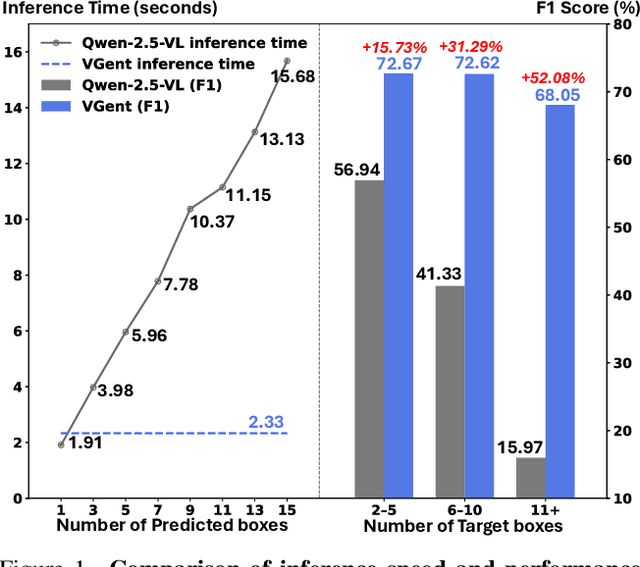
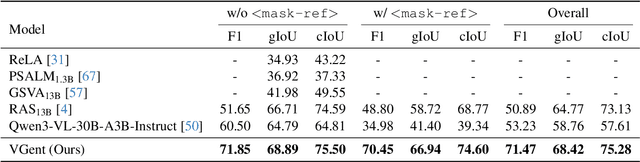
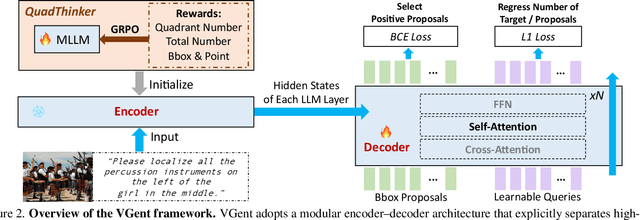
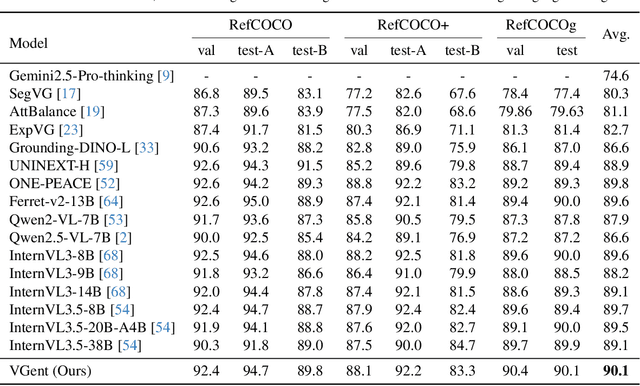
Current visual grounding models are either based on a Multimodal Large Language Model (MLLM) that performs auto-regressive decoding, which is slow and risks hallucinations, or on re-aligning an LLM with vision features to learn new special or object tokens for grounding, which may undermine the LLM's pretrained reasoning ability. In contrast, we propose VGent, a modular encoder-decoder architecture that explicitly disentangles high-level reasoning and low-level bounding box prediction. Specifically, a frozen MLLM serves as the encoder to provide untouched powerful reasoning capabilities, while a decoder takes high-quality boxes proposed by detectors as queries and selects target box(es) via cross-attending on encoder's hidden states. This design fully leverages advances in both object detection and MLLM, avoids the pitfalls of auto-regressive decoding, and enables fast inference. Moreover, it supports modular upgrades of both the encoder and decoder to benefit the whole system: we introduce (i) QuadThinker, an RL-based training paradigm for enhancing multi-target reasoning ability of the encoder; (ii) mask-aware label for resolving detection-segmentation ambiguity; and (iii) global target recognition to improve the recognition of all the targets which benefits the selection among augmented proposals. Experiments on multi-target visual grounding benchmarks show that VGent achieves a new state-of-the-art with +20.6% F1 improvement over prior methods, and further boosts gIoU by +8.2% and cIoU by +5.8% under visual reference challenges, while maintaining constant, fast inference latency.
OIDA-QA: A Multimodal Benchmark for Analyzing the Opioid Industry Documents Archive
Nov 14, 2025The opioid crisis represents a significant moment in public health that reveals systemic shortcomings across regulatory systems, healthcare practices, corporate governance, and public policy. Analyzing how these interconnected systems simultaneously failed to protect public health requires innovative analytic approaches for exploring the vast amounts of data and documents disclosed in the UCSF-JHU Opioid Industry Documents Archive (OIDA). The complexity, multimodal nature, and specialized characteristics of these healthcare-related legal and corporate documents necessitate more advanced methods and models tailored to specific data types and detailed annotations, ensuring the precision and professionalism in the analysis. In this paper, we tackle this challenge by organizing the original dataset according to document attributes and constructing a benchmark with 400k training documents and 10k for testing. From each document, we extract rich multimodal information-including textual content, visual elements, and layout structures-to capture a comprehensive range of features. Using multiple AI models, we then generate a large-scale dataset comprising 360k training QA pairs and 10k testing QA pairs. Building on this foundation, we develop domain-specific multimodal Large Language Models (LLMs) and explore the impact of multimodal inputs on task performance. To further enhance response accuracy, we incorporate historical QA pairs as contextual grounding for answering current queries. Additionally, we incorporate page references within the answers and introduce an importance-based page classifier, further improving the precision and relevance of the information provided. Preliminary results indicate the improvements with our AI assistant in document information extraction and question-answering tasks. The dataset is available at: https://huggingface.co/datasets/opioidarchive/oida-qa
Image Tokenizer Needs Post-Training
Sep 15, 2025Recent image generative models typically capture the image distribution in a pre-constructed latent space, relying on a frozen image tokenizer. However, there exists a significant discrepancy between the reconstruction and generation distribution, where current tokenizers only prioritize the reconstruction task that happens before generative training without considering the generation errors during sampling. In this paper, we comprehensively analyze the reason for this discrepancy in a discrete latent space, and, from which, we propose a novel tokenizer training scheme including both main-training and post-training, focusing on improving latent space construction and decoding respectively. During the main training, a latent perturbation strategy is proposed to simulate sampling noises, \ie, the unexpected tokens generated in generative inference. Specifically, we propose a plug-and-play tokenizer training scheme, which significantly enhances the robustness of tokenizer, thus boosting the generation quality and convergence speed, and a novel tokenizer evaluation metric, \ie, pFID, which successfully correlates the tokenizer performance to generation quality. During post-training, we further optimize the tokenizer decoder regarding a well-trained generative model to mitigate the distribution difference between generated and reconstructed tokens. With a $\sim$400M generator, a discrete tokenizer trained with our proposed main training achieves a notable 1.60 gFID and further obtains 1.36 gFID with the additional post-training. Further experiments are conducted to broadly validate the effectiveness of our post-training strategy on off-the-shelf discrete and continuous tokenizers, coupled with autoregressive and diffusion-based generators.